
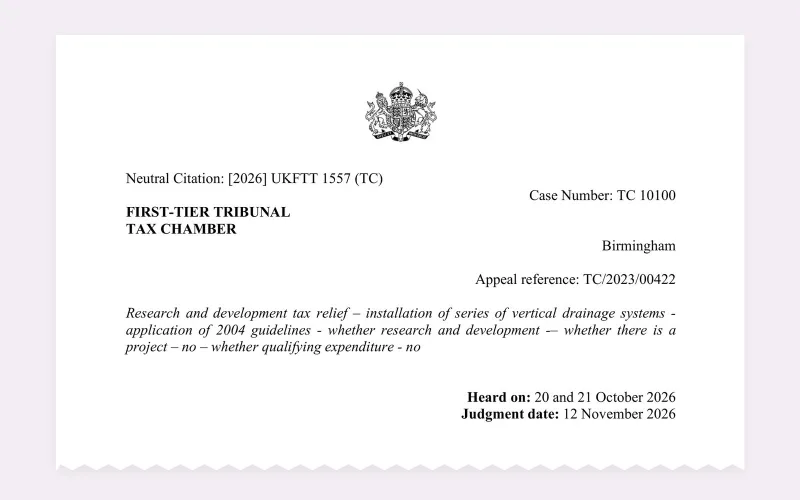
The First-tier Tribunal’s decision in Groundwater Dynamics Ltd v HMRC [2026] UKFTT 1557 (TC), released on 12 November 2026, turns on a point that matters to every R&D claimant: generating new knowledge is not enough on its own. Below is our initial view of the decision and what claimants can take from it.
Read the full judgment on the National Archives’ Case Law site (opens in new tab).
What the tribunal decided
On paper, some might think the company had a reasonable case. HMRC accepted that its work had generated new knowledge about vertical drainage systems. Both sides agreed that its expert was a competent professional, and for the purposes of deciding the appeal, the Tribunal accepted that the knowledge gained was not reasonably obtainable by a competent professional in the field.
However, it still lost.
The judge accepted that the company had a plan but found that its commercial plan to demonstrate the effectiveness of a technology to a cautious industry was too broad to amount to an R&D project under paragraph 19 of the Guidelines.
Each installation therefore had to be considered on its own merits, but there was insufficient evidence to establish which, if any, qualified.
Why the expenditure claim failed
The expenditure calculations didn't help either. A staff time percentage was also applied to most materials and subcontractor costs, only one employee timesheet was provided and some installations included in the calculations did not feature in the witness evidence. The expenditure claim failed independently of the project issue.
Identifying a project after the event
A related point worth noting is the distinction between retrospectively identifying an R&D project and retrospectively creating one. HMRC's Guidelines for Compliance, GfC3, support the former, but not the latter.
A company may legitimately only realise after completing a piece of work that resolving the uncertainties it encountered would constitute a scientific or technological advance. However, the project, and a method or plan to resolve those identified uncertainties, must have existed when the relevant costs were incurred.
Generating new technological knowledge does not, in itself, establish an entitlement to R&D tax relief.
Three lessons for R&D claimants
- Get the project boundaries right before calculating expenditure.
- Establish the uncertainties each project sought to resolve.
- Link the expenditure claimed to the qualifying activities.